Posts mit dem Label u-boat werden angezeigt. Alle Posts anzeigen

Montag, 16. Oktober 2017

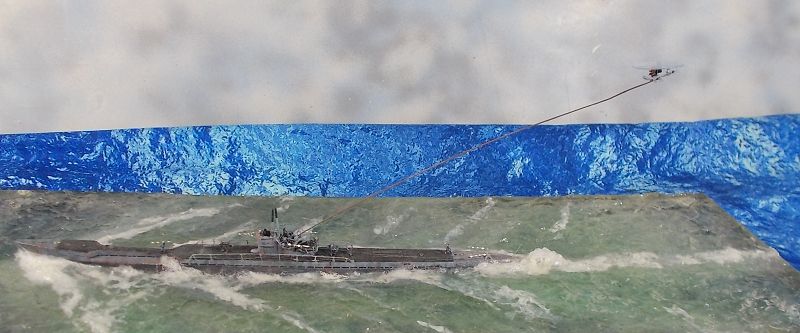
U-875 (Typ IX) with Focke Achgelis Fa 330 Bachstelze - Mirage hobby 1/400

I attach great importance to the statement that the symbols of the Nazi period ( Swastikas ) serve only a faithful reproduction of the models. A political attitude can and should not be derived from it. The generally applicable laws and regulations, which allow an exhibition of Nazi symbols, will therefore be satisfied.

----------------------------------------------------------------------------------------------
 

Ich lege grossen Wert auf die Feststellung, daß die Symbole der NS-Zeit ( Swastikas ) lediglich einer originalgetreuen Wiedergabe der Modelle dienen ! Eine politische Einstellung/ Gesinnung kann und sollte nicht davon abgeleitet werden.

Den allgemein geltenden Gesetzen und Richtlinien, die zwar eine Ausstellung von NS-Symbolen erlaubt, aber eine Verherrlichung verbietet, wird somit entsprochen!
 

----------------------------------------------------------------------------------------------

Die Focke-Achgelis Fa 330 „Bachstelze“ war ein motorloser Kleintragschrauber, der für den Einsatz auf U-Booten und Schiffen bestimmt war.  


Die Maschinen konnten bereits bei einer Geschwindigkeit von 30 km/h starten. Während der Schulung an Land wurde von der Ladefläche eines Lastwagens gestartet, der auf einem geraden Fahrbahnstück hin- und herfuhr, und auch wieder darauf gelandet. Im Einsatz wurden sie allein durch die Geschwindigkeit des U-Bootes und durch den Wind angetrieben und emporgehoben (Autorotation). Der Aufbau war äußerst einfach gestaltet und bestand aus einer Stahlrohrkonstruktion und einem 7,31 m im Durchmesser messenden Hauptrotor, der aus drei Rotorblättern bestand.

Die Tragschrauber ließen sich zusammenklappen. Sie wurden nicht in den Innenräumen der Schiffe oder U-Boote verstaut, sondern in zwei mit wasserdichten Deckeln verschließbaren großen Druckbehältern (60 cm Durchmesser), die senkrecht an dem Turm des U-Bootes montiert waren aufbewahrt. Einer der Behälter enthielt die drei Rotorblätter und die Nabe, der andere Rumpfgerüst, Steuerung und Leitwerk.

Der Start erfolgte von einem Starttisch, der in den sogenannten Wintergarten des U-Bootes montiert war. Der einzelne Beobachter hatte eine stark vergrößerte Sichtweite, was das Auffinden von Zielen verbessern sollte. Betrug die Sichtweite vom Turm des U-Boots in der Regel nicht mehr als 5 sm, konnte der Beobachter von der Bachstelze aus 25 sm blicken, da der Tragschrauber am 300 m langen Schleppseil eine Höhe von ca. 120 m erreichte.

Um die Maschinen auf einem U-Boot einsatzbereit zu machen, waren sieben Minuten notwendig, das Einpacken erfolgte in zwei Minuten. In Notfällen konnte der Pilot den Rotor abwerfen und dann mit dem Rest der Maschine an einem Fallschirm hängend landen. Mehr als 112 dieser einfachen, aber für ihre Zeit technisch hoch entwickelten Geräte wurden gebaut und auf den U-Booten des Typs IX D 2 eingesetzt.

Es sollen rund 200 Exemplare der Fa 330 bei Weserflug in Hoykenkamp endmontiert worden sein. Einige davon kamen 1945 nach Großbritannien und wurden bei dem Airborne Forces Experimental Establishment, RAF Beaulieu, untersucht. Ein weiterer Prototyp wurde nach dem Krieg in Frankreich als SNCASO SE-3101 fertiggestellt.

Da der Einsatz von einem U-Boot aus ein schnelles Abtauchen des U-Bootes verhinderte (bzw. ein Aufgeben des Fluggerätes und Zurücklassen des Piloten erforderte), war der Erfolg des Musters sehr begrenzt. Im weiteren Verlauf wurde die Möglichkeit einer Modifikation der Fa 330 zu einem Hubschrauber mittels eines 60-PS-Motors geprüft, jedoch als nicht machbar erachtet. Stattdessen wurde der äußerlich recht ähnliche, jedoch weitgehend eigenständige Fa 336 entworfen. Das Konzept enthielt ebenso einen 60-PS-Motor sowie einen konventionellen Heckrotor zum Drehmomentausgleich, kam aber aufgrund mangelnder Entwicklungskapazitäten nie über das Reißbrett hinaus.

Quelle: https://de.wikipedia.org/wiki/Focke-Achgelis_Fa_330

Video:  https://www.youtube.com/watch?v=6NtI-KS45xk


Ein einfacher Bausatz, der für diesen Kleinserien-Hersteller überraschend gut zusammenpasst und relativ leicht zu bauen ist. Lediglich die winzige Bachstelze ist zu grob ausgefallen und wurde von mir scratch gebaut.


Thanks for watching - Danke für's Anschauen.

Dienstag, 8. April 2014

Soviet U-Boat S-class Srednyaya / Stalinets - soviet producer 1/700

The S-class or Srednyaya (Russian: Средняя, "medium") submarines were part of the Soviet Navy's underwater fleet during World War II. Unofficially nicknamed Stalinets (Russian: Cталинец, "follower of Stalin"; not to be confused with the submarine L-class L-2 Stalinets of 1931), boats of this class were the most successful and achieved the most significant victories among all Soviet submarines. In all, they sank 82,770 gross register tons (GRT) of merchant shipping and seven warships, which accounts for about one-third of all tonnage sunk by Soviet submarines during the war.


The history of the S-class represents quite an interesting turn in warship development. It was a result of international collaboration between Soviet and German engineers that resulted in two different (but nevertheless related) classes of submarines often pitted against each other in the war.
In the early 1930s the Soviet government started a massive program of general rearmament, including naval expansion. Submarines were one key point of this program, but currently available types did not completely satisfy naval authorities. The recently developed Shchuka class submarine was satisfactory, but it was designed specifically for shallow Baltic Sea service and lacked true ocean-going capabilities. The larger boats of the Soviet Navy were quickly becoming obsolete.
As a result, the government commissioned several engineers to search for a suitable design for a medium-sized ocean-going submarine, and this search soon brought success. After its defeat in World War I, the German Weimar Republic was forbidden under the terms of the Treaty of Versailles to have submarines or build them in its own yards. Germany circumvented this restriction by creating various subsidiaries of their shipbuilding and design companies in third countries. One of these proxies, the Netherlands-based NV Ingenieurskantoor voor Scheepsbouw (IvS), a subsidiary of Deutsche Schiff- und Maschinenbau AG-AG Weser, was developing a submarine that matched Soviet requirements. The Spanish government, during General Primo de Rivera's dictatorship, showed interest in obtaining such a submarine for the Spanish Navy. Several German naval officers (including Wilhelm Canaris) visited Spain and struck a deal with a Spanish businessman, Horacio Echevarrieta. A single submarine was built in 1929–1930, and was tested at sea early in 1931, under the manufacturer's designation of submarino E-1, since no navy had yet commissioned the ship.

The government of the Second Spanish Republic showed a clear preference for British submarine designs. Designers and builders then went to offer the design and the boat for sale to return their cost. Soviet engineers, among others, visited the yard in 1932 and were generally satisfied with the design, but suggested several modifications and improvements, in expectation of future local production. Another group of engineers went next year to the IvS office in The Hague, as well as the Bremen office of Deschimag, and then attended the completed boat's trials in Cartagena. Echevarrieta's imprisonment for his connection with the October 1934 Revolution made the Spanish Navy lose any interest in the submarine, which was finally sold to the Turkish Navy in 1935, in which it served until 1947 under the name of Gür.
Despite several problems encountered during the boat's trials, the design was considered satisfactory and the Soviet government bought it, with the condition Deschimag make the suggested improvements and assist with the building of several prototypes, which it did. The modifications resulted in a significant reworking of the project, redesignated E-2. Blueprints were received from Germany at the end of 1933 and on August 14, 1934, the design was officially approved for production, designated IX series. Construction of the first two prototypes commenced in December 1934 at the Baltic Shipyard (Baltiysky zavod) in Leningrad, using partially German equipment. In April 1935, the third prototype was laid down as well.
By the time the third prototype was started, it became obvious building the boats with foreign equipment would be too expensive, so the design was reworked slightly to use only domestically produced equipment. The result of this modification was the IX-bis series and went to mass production in 1936. Initially the first prototypes received the official designations N-1, N-2, and N-3 (Nemetskaya, "German") but in October 1937 they were re-designated S-x (Srednyaya, "Medium"). In the West, the class was much more widely known for its nickname, Stalinets, coined with reference to earlier boats of the Leninets type, but it was never featured in any official documents.
The E-1 boat was eventually sold to Turkey in 1935, and was a prototype for German's own boats of Type I. This design was later improved to become the famous Type VII and Type IX U-boats of the Kriegsmarine.

From Wikipedia, the free encyclopedia